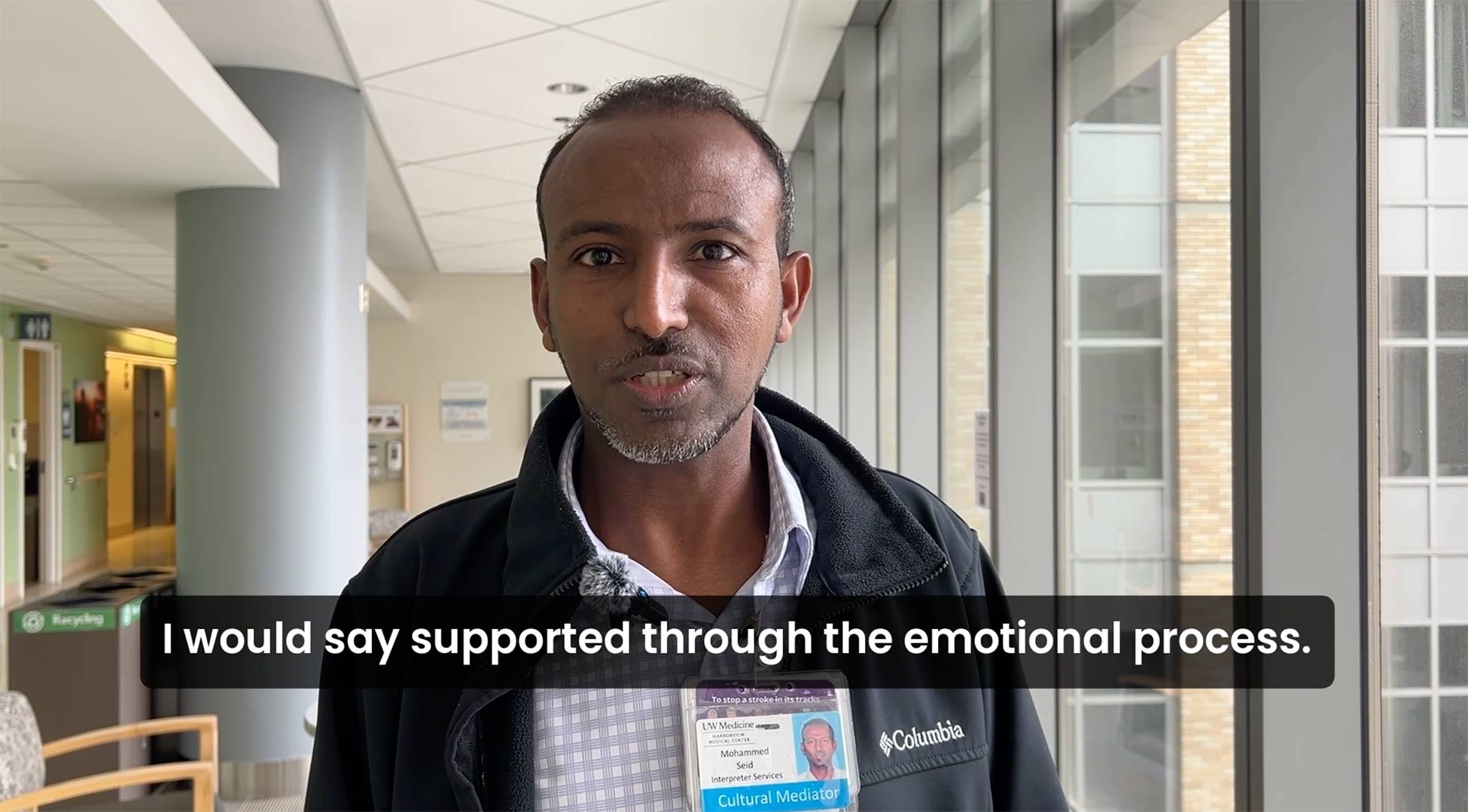
Tigrinya CCM- Removing language & cultural barriers
Posted on May 24, 2024 | By EthnoMed
Mohammed helps patients navigate the medical system and overcome cultural barriers to the care they need.
Primarily authored by EthnoMed Director Dr. Carey Jackson, these posts explore current issues and spotlight organizations related to immigrant and refugee health care. We also occasionally feature guest authors.
Mohammed helps patients navigate the medical system and overcome cultural barriers to the care they need.

Most medical care takes place outside of the physician-patient encounter. Phlebotomy in the lab, “clean catch” urines, EKG’s, colonoscopy preps, […]

It is inevitable not to feel optimistic and yearn for long-awaited positive changes that would impact our immigrant communities. For decades, immigrant communities have been put on the back burner, and protection for the more than 11 million undocumented individuals in the U.S. has not been a priority for the country. Family separation, long waiting lists for family reunifications, limited protections for immigrant victims, children and youth with dreams in limbo, zero avenues to legal for farmworkers, the fear that at any moment a person will be arrested for lack of papers, and many more difficult situations are today’s reality. Read more…

Among the health disparities prevalent among asylum seekers, refugees and immigrants is a history of political violence in the form of imprisonment, war fare, interrogation, threats and torture. You will find that this experience is shared by Vietnamese survivors of the re-education camps, Egyptian students, gay men from Pakistan, Ethiopian shopkeepers, Angolan obstetricians, and the political opposition from Congo. In the diversity of occupation, gender and ethnicity is a shared experience of a violent suppression of democracy that plays itself out in their lives through dislocation, chronic pain and disease, sometimes for decades. Read more…

EthnoMed is a program and website within Harborview Medical Center’s Interpreter Services Department that provides information about cultural beliefs, medical issues and other topics related to the health care of immigrants and refugees. Founded in 1994 in partnership with UW Health Sciences Library, the website was developed for clinicians and health care providers working with immigrant and refugee populations in the greater Seattle area. Read more…

Being poor can be like treading water with the waterline right under your nose. The slightest ripple and you choke, a wave will submerge you. The novel coronavirus pandemic is a tsunami for those living in poverty. As a recent New York Times article illustrates, communities living in crowded conditions, with uncontrolled chronic diseases like diabetes and hypertension, marginalized by the lack of comprehensible health information, and mistrusting the current systems to treat them fairly will be disproportionately ravaged by Covid-19. We have seen this in the past with tuberculosis, HIV, and hepatitis B. But the novel coronavirus acts faster and in some cases more aggressively and so reveals disparities even more dramatically. Read more…

Migrants exist in two worlds simultaneously: one in the country of asylum and the other through their calls, connections, and visits, to the people back home. Global warming is changing both worlds; in fact it is why many have been forced to migrate. Recently, world representatives met in Poland to coordinate efforts to address climate change. As they acknowledge it is almost too late, many realize the stakes are far too high to trust politicians alone to handle the broad cultural changes needed to address environmental collapse. Read more…

It is critical for those of us charged with the well-being of children and families to speak out for their protection, as we have been reminded this week by the zero-tolerance policy separating and detaining families. We are a Washington State coalition of health professionals and public health practitioners; whose mission is to advocate and care for immigrants, refugees, and asylum seekers. The forceful separation of children from parents and the recent relocation of some of these children and parents to Washington State makes this national crisis also a local concern. Read more…

The trust between physician and patient is a core tenant of the medical profession. By extension, trusting relationships with nurses,technicians, hospitals and clinics are where this relationship plays out. This trust is now threatened by U.S. Immigration and Customs Enforcement (ICE). In a startling breach of precedent, ICE agents have begun to target clinics and hospitals to enforceimmigration policy. It is our opinion that these enforcement actions actively jeopardize patient care. Read more…

Fourteen years ago the Institutes of Medicine published Unequal Treatment: Confronting Racial and Ethnic Disparities in Health Care. Among their recommendations was the observation that to find disparities in care, health systems must first collect Race, Ethnicity, and Language (REAL) data at registration. Many health systems across the country began to make this effort. But then in 2008 the economy collapsed and health systems found themselves launching a rearguard effort to shore up their IT and EMR departments as budgets were cut and IT work forces downsized.Since then, the Affordable Care Act was passed and equity became a pillar of care. Electronic medical records were enhanced and since have evolved to facilitate the sharing of medical information. Read more…

The rhetoric around immigration has again reached a fever pitch. It did after 9/11, it has repeatedly, and it has again. Migrant children fleeing intolerable gang and domestic violence in Central America have crowded the Southern border. Refugees fleeing Syria are swarming over Eastern Europe and a chronic flow of migrants from East Africa stream north and cross the Mediterranean in precarious flotillas. The West feels under siege and frightened. There are many with distinct political agendas that capitalize on this fear and propagate unwarranted anxiety for their own ends. We see this in national political debates and we see it daily in local politics. Read more…

Hepatitis B research traditionally has been underfunded, as diseases such as HIV and hepatitis Chave been given higher priority by funding agencies. More recently, the NIH has established the Hepatitis B Research Network (HBRN), a group of 28 clinical sites across the US and Canada designed to address important clinical questions pertaining to hepatitis B in both children (7 sites)and adults (21 sites). Seattle has both adult and pediatric sites. Broad questions being asked by the HBRN include why some develop severe liver disease and liver cancer while others have inactive disease, how to improve the response to current treatments, and whether indefinite treatment is really required in those who have e antigen-negative disease. Read more…